
Disposable Cup-Shaped Dental Polishing Brush — Nylon Bristle Prophy Brush for Curved Surface Prophylaxis
Source Disposable Cup-Shaped Dental Polishing Brush — Nylon Bristle Prophy Brush for Curved Surface Prophylaxis, with 6 colors.
描述
Disposable Cup-Shaped Dental Polishing Brush — Nylon Bristle Prophy Brush for Curved Surface Prophylaxis
- Single-use cup-shaped nylon bristle polishing brush with a concave bowl geometry bristle arrangement designed to conform to the convex labial, buccal, and emergence profile surfaces of anterior and posterior teeth, as well as implant-supported crown surfaces
- Concave bristle tip geometry inversely matches the convex curvature of anterior and posterior tooth surfaces — maximizing simultaneous bristle tip contact across curved surfaces in a single rotational pass
- Available in two ferrule formats: standard narrow cylindrical ferrule (straight shank style) and wider flared ferrule (cup-mount style), both with latch-type stainless steel shank for low-speed latch-type contra-angle handpieces
- Fine nylon bristles securely retained in stainless steel ferrule with consistent cup-profile bristle geometry throughout clinical use
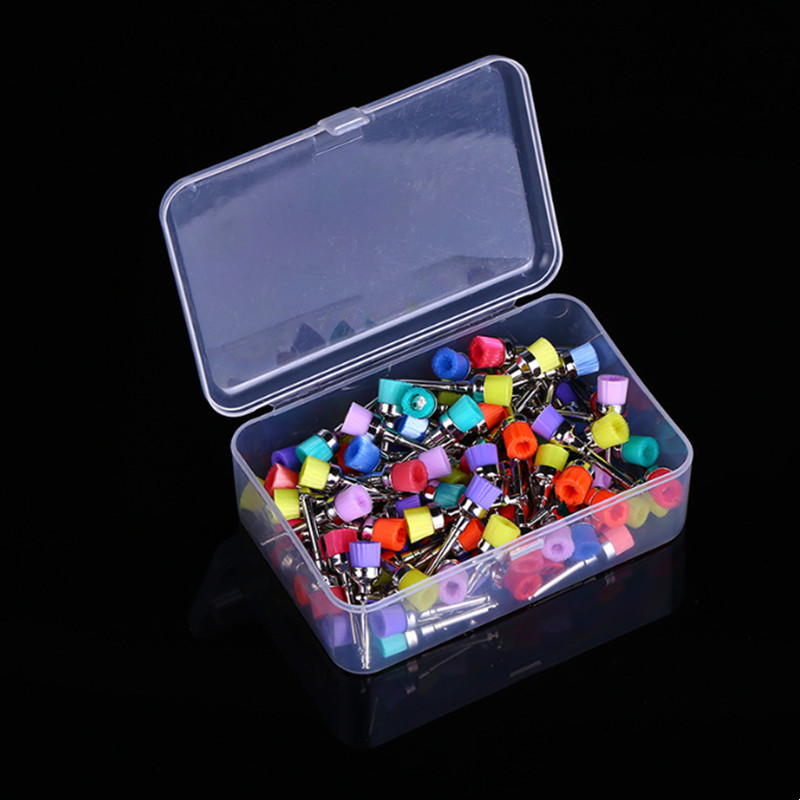
- White bristle standard; also available in multiple colors including blue, red, yellow, pink, green, purple, and teal in the cup-mount format
- Supplied in clear hinged-lid plastic storage boxes for clean, organized chairside access
- Single-use design eliminates cross-contamination risk between patients
- Shelf life: 3 years
Details
The Disposable Cup-Shaped Dental Polishing Brush is a single-use nylon bristle prophylaxis attachment with a bowl-geometry bristle arrangement, designed specifically for polishing the convex labial surfaces of anterior teeth, buccal and lingual curves of posterior dentition, and the smooth convex emergence profiles of implant-supported crowns and natural crown contours. The cup-shaped bristle geometry is the functional counterpart to a convex tooth surface: where a flat-top brush makes full contact only at the apex of a convex surface and loses peripheral bristle contact toward the surface margins, the cup-shaped brush presents a concave working surface that follows the convex tooth profile — maintaining bristle tip contact across the full surface width from the first rotational stroke.
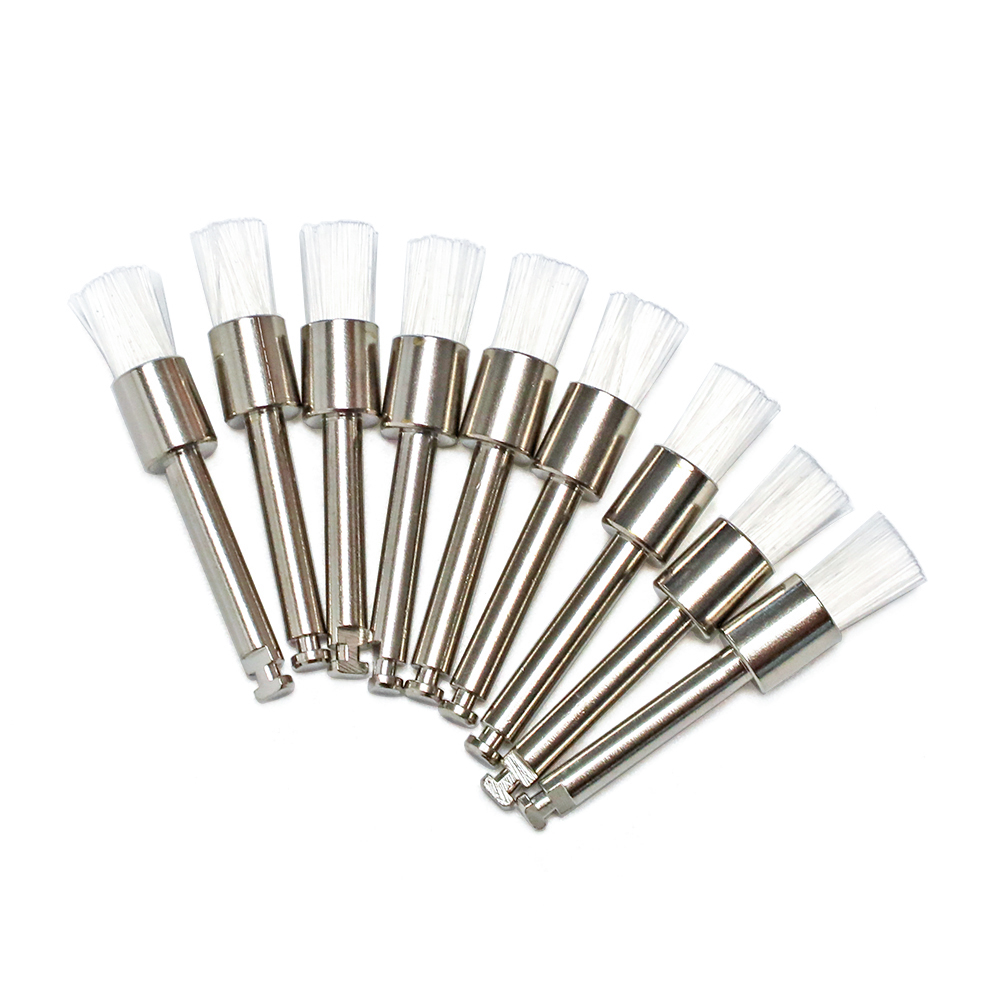
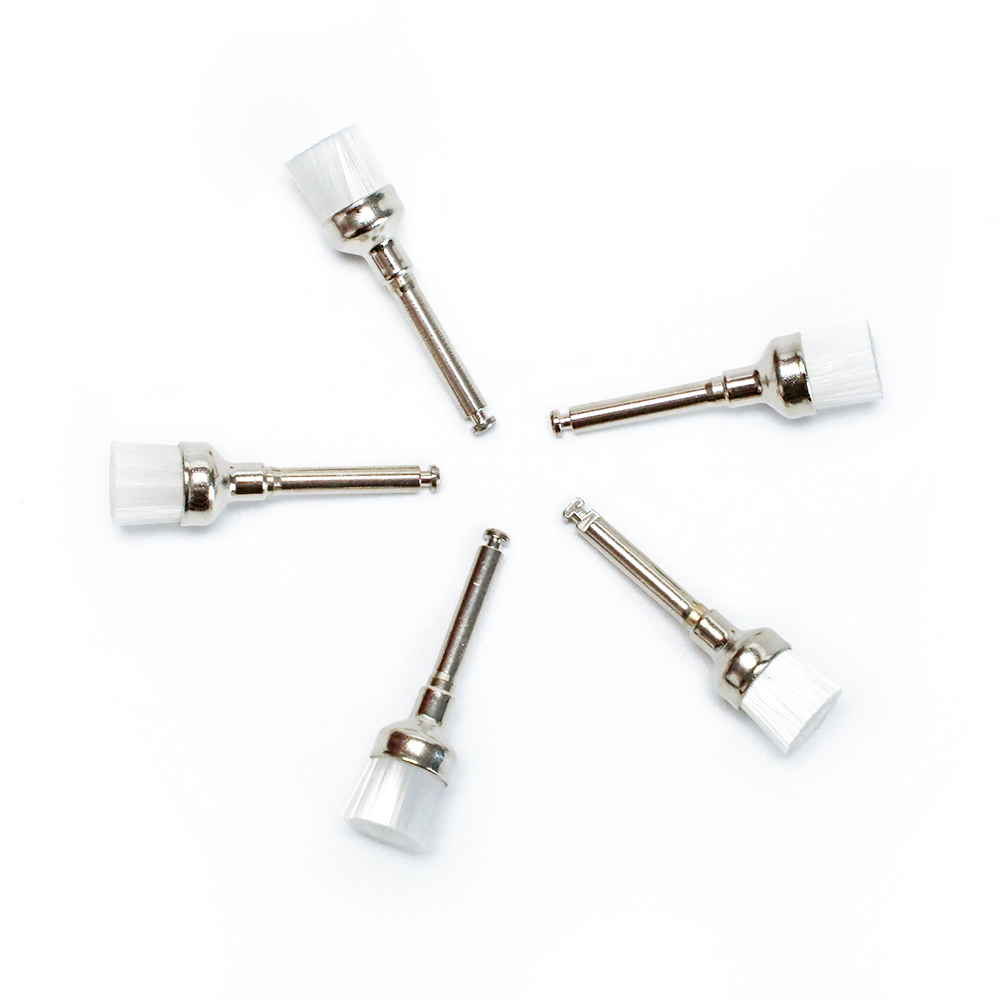
As visible across the product images, the cup-shaped polishing brush is available in two ferrule configurations. The narrow straight cylindrical ferrule format — shown in white bristle in the fan-arrangement and close-up detail images — produces a compact cup-shaped bristle head suited to anterior labial surface polishing and targeted curved-surface work where precise margin control is required. The wider flared cup-mount ferrule format — shown in multiple colors in the storage box image — produces a larger-diameter cup head suited to broader posterior buccal surface coverage and larger-radius convex surfaces. Both configurations use the same latch-type stainless steel shank compatible with standard low-speed contra-angle handpieces. The product is supplied in clear hinged-lid storage boxes.
Feature
- The concave cup-geometry of the bristle arrangement presents a bowl-shaped working surface that follows the convex curvature of labial, buccal, and lingual tooth surfaces — maintaining simultaneous contact between the bristle tips and the tooth surface across the full width of the brush head as it rotates, rather than making progressive edge-to-center contact that characterizes a flat-top brush on a convex surface.
- On convex anterior labial surfaces — the primary polishing target for this brush format — the cup-shaped bristle head maintains contact from the mesial margin to the distal margin of the labial face in a single rotational pass, delivering prophy paste coverage and stain-removal contact across the full surface width without requiring the clinician to angle the brush to follow the surface curvature manually during the stroke.
- The individual nylon bristles within the cup arrangement flex under surface contact, adapting the bowl geometry to the specific radius of each tooth surface encountered — a narrower anterior labial surface receives a tighter cup contact geometry, and a broader posterior buccal surface receives a wider contact arc, without requiring a different brush for each tooth size variant.
- The narrow cylindrical ferrule format, visible in the product images as the compact white-bristle version with multiple shank sizes, provides precise margin control during anterior labial surface polishing — the narrow ferrule diameter keeps the working perimeter of the cup well within the labial surface boundaries and away from the gingival margin, reducing the risk of inadvertent gingival tissue contact during curved-surface strokes on narrow anterior teeth.
- The wider flared cup-mount ferrule format provides a larger cup diameter for broader buccal surface coverage on posterior teeth and for polishing the larger-radius emergence profiles of implant-supported posterior crowns, reducing the number of strokes required to achieve complete curved-surface coverage on larger tooth forms.
- The latch-type stainless steel shank provides tool-free engagement with standard low-speed latch-type contra-angle handpieces, enabling fast single-handed brush changes without workflow interruption between patients and surface zones.
- Supplied in clear hinged-lid storage boxes allowing clean single-brush dispensing with immediate re-closure to protect remaining brushes from operatory contamination between uses.
Cup-Shaped Polishing Brush — Specifications
| Parameter | Specification |
|---|---|
| Product Name | Disposable Cup-Shaped Dental Polishing Brush |
| Bristle Profile | Cup-Shaped / Bowl Geometry (Concave) |
| Bristle Material | Nylon |
| Ferrule Format | Narrow Cylindrical Ferrule; Wide Flared Cup-Mount Ferrule |
| Ferrule Material | Stainless Steel |
| Shank Type | Latch-Type Stainless Steel |
| Shank Compatibility | Standard Low-Speed Latch-Type Contra-Angle Handpiece |
| Standard Bristle Color | White |
| Additional Colors (Cup-Mount) | Blue, Red, Yellow, Pink, Green, Purple, Teal |
| Packaging | Clear Hinged-Lid Storage Box |
| Use | Single-Use |
| Primary Application | Anterior labial surface polishing; posterior buccal/lingual curved surface polishing; implant crown emergence profile maintenance |
| Storage | Well-ventilated; moisture-proof; indoor temperature ≤ 45°C |
| Shelf Life | 3 Years |
Working Principle
The Cup-Shaped Polishing Brush transmits rotational force from the low-speed handpiece through the stainless steel latch shank and ferrule to the nylon bristle bundle, driving the concave cup-geometry bristle arrangement through its rotational arc at the tooth surface. The functional principle of the cup-shaped brush rests on geometric complementarity: a convex tooth surface and a concave brush tip are geometrically matched surfaces that achieve maximum contact area at a given contact pressure, in contrast to a flat tip on a convex surface where contact is limited to the surface apex.
When the rotating cup-shaped tip contacts a convex tooth surface, the peripheral bristles of the cup rim make initial contact at the lateral margins of the surface, and as light pressure is applied, the inner bristles progressively engage the surface toward the central apex — resulting in a contact zone that spans the full width of the cup head across the surface rather than concentrating at the center as a flat tip would. This distributed contact delivers prophy paste to the full contacted surface width simultaneously, reducing the number of strokes required for complete surface coverage and ensuring that stain removal force is applied evenly across the full labial or buccal surface face rather than requiring multiple angled approach strokes to cover the surface margins.
The individual nylon bristles within the cup geometry flex independently under contact, accommodating the specific radius of curvature of each tooth surface they contact. A narrower anterior tooth with a tighter labial convexity receives deeper bristle engagement at the cup center and lighter engagement at the cup periphery; a broader posterior tooth with a flatter buccal curvature receives more uniform bristle engagement across the full cup width. This adaptive contact behavior occurs passively without requiring clinician adjustment, maintaining effective polishing contact across the range of surface radii encountered in a complete dentition prophylaxis sequence.
Clinical Practice of the Disposable Cup-Shaped Polishing Brush
1. Pre-Procedure Setup
- Select the appropriate ferrule format for the procedure: narrow cylindrical format for anterior labial surface polishing and targeted curved-surface work on narrow tooth forms; wide flared cup-mount format for posterior buccal and lingual curved surface polishing and implant crown emergence profile maintenance.
- Insert the latch shank into the contra-angle handpiece and confirm positive latch engagement; apply light lateral force to the brush head to verify secure attachment before activation.
- Run the handpiece unloaded at low speed briefly before intraoral use; confirm that the cup-shaped bristle head rotates smoothly without visible eccentric wobble at the cup rim — cup-rim eccentricity reduces the geometric contact advantage of the cup profile on convex surfaces.
- Load the cup with prophy paste by pressing the concave bristle surface lightly against the paste in the dappen dish; the bowl geometry retains paste within the cup depression, providing a well-centered paste charge that is released progressively from the cup interior during the first polishing strokes on the tooth surface.
2. Intraoperative Management
- Apply the loaded cup to the convex labial or buccal surface with light, even contact pressure; allow the cup geometry to conform to the surface curvature naturally without forcing additional pressure to increase contact — excessive pressure collapses the cup geometry by over-deflecting the peripheral bristles, reducing the contact width advantage of the cup profile.
- Use light sweeping strokes from the gingival margin toward the incisal or occlusal edge for anterior labial surfaces, covering the full mesiodistal width of the surface in overlapping vertical strokes; the cup-shaped tip maintains marginal contact throughout the stroke without requiring the handpiece to be tilted to follow the surface curvature.
- For posterior buccal surface polishing, position the cup against the buccal surface curvature and use horizontal sweeping strokes from the gingival margin toward the occlusal surface, covering the full vertical height of the buccal zone in two to three overlapping passes per tooth.
- For implant crown emergence profile polishing, use the cup-shaped brush with an implant-compatible or non-abrasive paste; the cup geometry is well-suited to the smooth convex emergence profile of implant-supported crowns, maintaining bristle tip contact across the curved crown profile without the abrupt margin contact that a rubber cup rim can generate at the crown-implant or crown-abutment interface.
- Reload the brush with prophy paste between teeth as needed; the cup interior retains paste more effectively than a flat-top brush between strokes, but the broader contact area of the cup depletes the paste charge more rapidly per tooth than a pointed brush on a smaller target zone.
- Monitor the gingival margin during labial and buccal surface polishing; the cup-shaped brush maintains contact toward the gingival margin more effectively than a flat-top brush on convex surfaces, which increases the precision required when approaching the marginal gingiva at the inferior extent of the labial stroke.
3. Post-Procedure Disposal
- Remove the brush from the handpiece latch by pressing the latch release and withdrawing the shank axially.
- Discard immediately after each patient use; single-use only. Do not reuse, re-sterilize, or re-disinfect.
- Replace the storage box lid after removing the used brush to protect remaining brushes from operatory aerosol and surface contamination.
- Dispose of used brushes in accordance with local clinical waste regulations.
The Function of the Disposable Cup-Shaped Polishing Brush
The Cup-Shaped Polishing Brush performs the specific prophylaxis function that flat-top brushes and rubber polishing cups address imperfectly on convex anterior and posterior curved surfaces: delivering uniform rotary polishing contact and prophy paste coverage across the full width of a convex surface in a single rotational pass, without requiring multiple angled approach strokes to compensate for the central-contact limitation of a flat or cup-rim working surface on a convex tooth form.
The anterior labial surface is the clinical zone where the cup-shaped brush provides its most distinct functional advantage over alternative polishing formats. The labial surfaces of maxillary and mandibular anterior teeth are among the most cosmetically significant surfaces in the dentition — stain on these surfaces is immediately visible and is a primary patient complaint driving prophylaxis appointments. They are also convex surfaces with relatively tight radii of curvature, particularly on narrow mandibular incisors, where neither a flat-top brush nor a rubber cup rim maintains full-width surface contact in a single approach. The cup-shaped bristle geometry resolves this by following the convex surface from margin to margin, delivering polishing contact and paste coverage across the full labial face in each rotational stroke — reducing procedural time for anterior surface polishing and producing more complete stain removal coverage per pass than alternative brush or cup formats on the same surface geometry.
The availability of both narrow cylindrical and wide flared cup-mount ferrule formats extends this geometric advantage across the full range of tooth sizes and curved surface applications in a complete prophylaxis sequence — from the narrow labial surfaces of mandibular incisors to the broader buccal curves of maxillary molars and the emergence profiles of implant-supported posterior crowns — without requiring multiple different product lines to address different tooth size categories within the cup-shaped brush application zone.
Important Notes for Using the Disposable Cup-Shaped Polishing Brush
- For use with latch-type contra-angle handpieces meeting technical and hygienic standards only. Confirm latch engagement before every intraoral use; apply light lateral force to the brush head to verify attachment security.
- Do not apply heavy contact pressure to increase surface coverage on convex surfaces. Heavy pressure over-deflects the peripheral bristles of the cup, collapsing the bowl geometry and reducing the cup profile to a functionally flat contact surface — eliminating the geometric advantage that distinguishes the cup-shaped brush from a flat-top format. Maintain light, consistent pressure that allows the cup geometry to conform to the surface naturally.
- Monitor gingival margin proximity during anterior labial surface polishing. The cup-shaped geometry maintains contact toward the gingival extent of the labial surface more effectively than a flat-top brush, which increases the risk of inadvertent gingival tissue contact at the inferior stroke boundary if the stroke is extended beyond the gingival margin onto the soft tissue. Terminate each downward stroke at the gingival margin, not beyond it.
- Confirm prophy paste compatibility with the surface material before use on implant crowns and ceramic restorations. Use non-abrasive or implant-compatible paste on implant components and ceramic crown surfaces; standard abrasive prophy paste may alter surface gloss on ceramic restorations under sustained rotational contact.
- Stop using immediately if bristle loss, cup geometry distortion, or shank loosening is observed during use. Cup geometry distortion — where the bristle arrangement no longer holds its concave profile under light load — indicates ferrule or bristle bonding failure that reduces the functional contact advantage of the cup profile.
- Do not use the cup-shaped brush as a substitute for the pointed brush in fissure, embrasure, or concave restoration margin polishing applications. The cup-shaped geometry is designed for convex surface conformance; it does not access concave anatomical zones and will not provide effective cleaning in fissures or interproximal embrasures.
- Single-use only. Destroy after use. Do not reuse, re-sterilize, or re-disinfect. Store in a well-ventilated, moisture-proof environment at indoor temperature not exceeding 45°C.
评价
目前还没有评价