
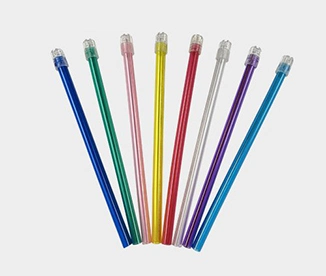
Saliva Ejectors With Fixed Head
描述
Saliva Ejectors with Fixed Head
- Medical grade PVC raw material
- Smooth tips for more comfortabe experience
- Easy form and maintain shape
- Various colors option, accept OEM colors
- Available round tip or small flat tip option
Description
Saliva ejector, also known as dental suction tubes, are essential instruments in dental care that can significantly improve procedure efficiency, patient comfort and infection control. They play an important role in dental procedures by removing excess saliva, blood, plaque and other oral fluids from the mouth.
A saliva ejector generally consists of a flexible plastic tube and a tip. It’s made of medical- grade materials similar as polyvinyl chloride( PVC). The tip can be placed near the throat where saliva gathers or under the tongue. This soft and flexible tip can minimize patient discomfort as much as possible.
Feature
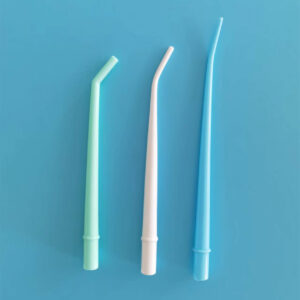
- The saliva ejector feature adjustable angles to better access the deep areas of the oral cavity. Smaller tips are also available for pediatric use.
- The surfaces have an antibacterial coating which inhibits bacterial growth on the device and improves hygienic standards.
- The suction force is adjustable to meet patient needs and treatment requirements, ensuring optimal fluid removal.
- Ethylene oxide sterilization ensures microbial viability <10^-6, package breakage detection sensitivity up to 0.5mm gap, general validity 24 months
Our saliva ejectors are available in round, flat, fixed and removable tips, please inquiry our sales team for details before purchasing!
Saliva Ejectors Working Principle
The saliva ejectors achieves liquid suction through the negative pressure principle, and its core component is medical grade vacuum pump system. When the device is in operation, the Venturi effect creates a stable negative pressure gradient of -40kPa to -80kPa in the lumen of the tube.
The petal-like opening at the front of the saliva ejector is fluid-optimized to fit into the gumline for precise directional suction. It quickly sucks up the cooling water generated by dental high-speed handpieces, stained blood and saliva mixture. Clinical tests have shown that the saliva ejector can control the humidity in the surgical field to less than 35%, which significantly improves the bond strength of the light-cured resin.
1. Installation process
- Check the integrity of the saliva ejector package
- Connect the tube vertically to the suction device on the treatment table and test the stability of negative pressure.
- Adjust the suction angle to 120°-135° to avoid touching the uvula.
2. Intraoperative management
- Keep the mouth of the tube 3-5mm away from the operating area during continuous suction to prevent damage to the oral mucosa caused by large suction force.
- Check the volume of the fluid collection bottle every 15 minutes to avoid overloading and backflow.
- Switch to gentle mode (<20kPa) for pediatric patients.
- For more viscous liquids, sometimes a three-in-one gun is used to flush while suctioning with a saliva ejector tube, which is a more efficient combination.
3. Post-operative treatment
- Immediately put into the special yellow medical waste container
- Perform a 30-second water + 15-second disinfectant rinse cycle on the treatment table tubing.
The Function of the Saliva Ejector
Most dental chairs are equipped with two suction ports: a high-suction port and a low-suction port, each paired with a corresponding high volume suction tip and low volume suction tips. The low volume suction tip referred to here is typically the saliva ejector, which is a suction tool used in conjunction with the high volume suction tip during dental procedures and serves as an essential component of the dental suction system. Unlike the high volume suction tip, it has a smaller diameter and weaker suction power. However, the saliva ejector is fitted with a filter-like cap and its tube body can be freely bent, making it more flexible to use than the high volume suction tip.
As the name suggests, the saliva ejector is used to remove saliva, blood, and cooling water from dental handpieces from the oral cavity, thereby improving surgical visibility. However, when encountering solid debris or viscous liquids, the high volume suction tip must be used instead.
Important Notes for Using Saliva Ejectors
- First, select the appropriate type of saliva ejector based on the patient’s oral condition. Saliva ejectors are categorized by cap type into flat-cap and round-cap models. Flat-cap saliva ejectors provide better adhesion and slightly stronger suction; round-cap models are easier to maneuver.
- Next, inspect the saliva ejector for any cracks or damage and ensure the suction system is functioning properly. You may test the suction power by turning on the device first.
- If the procedure is lengthy, need use the saliva ejector tube or high volume suction tip multiple times for suction. Apply a thick layer of Vaseline to the patient’s mouth corners in advance to prevent discomfort from prolonged friction.
- The saliva ejector tube can be bent to adapt to narrow oral environments. However, if improper bending techniques or poor tube quality cause cracks in the tube body, replace it immediately.
- Unlike high volume suction tip, saliva ejectors are typically disposable and should be disposed of as surgical waste after single use to prevent cross-infection.
评价
目前还没有评价