
Disposable Dental Polishing Brush — Nylon Bristle Prophy Brush for Handpiece Prophylaxis
描述
Disposable Dental Polishing Brush — Nylon Bristle Prophy Brush for Handpiece Prophylaxis
- Single-use nylon bristle polishing brush designed for tooth surface cleaning, stain removal, interproximal polishing, implant surface maintenance, and restoration finishing with low-speed latch-type handpieces
- Available in three bristle head profiles: flat-top brush, pointed/tapered brush, and cup-shaped brush — covering the full range of tooth surface geometries and access requirements
- Fine nylon bristle cluster bonded into a stainless steel ferrule cup for secure bristle retention throughout the polishing stroke without bristle loss or splaying under rotational load
- Latch-type stainless steel shank for tool-free engagement with standard low-speed latch-type contra-angle handpieces
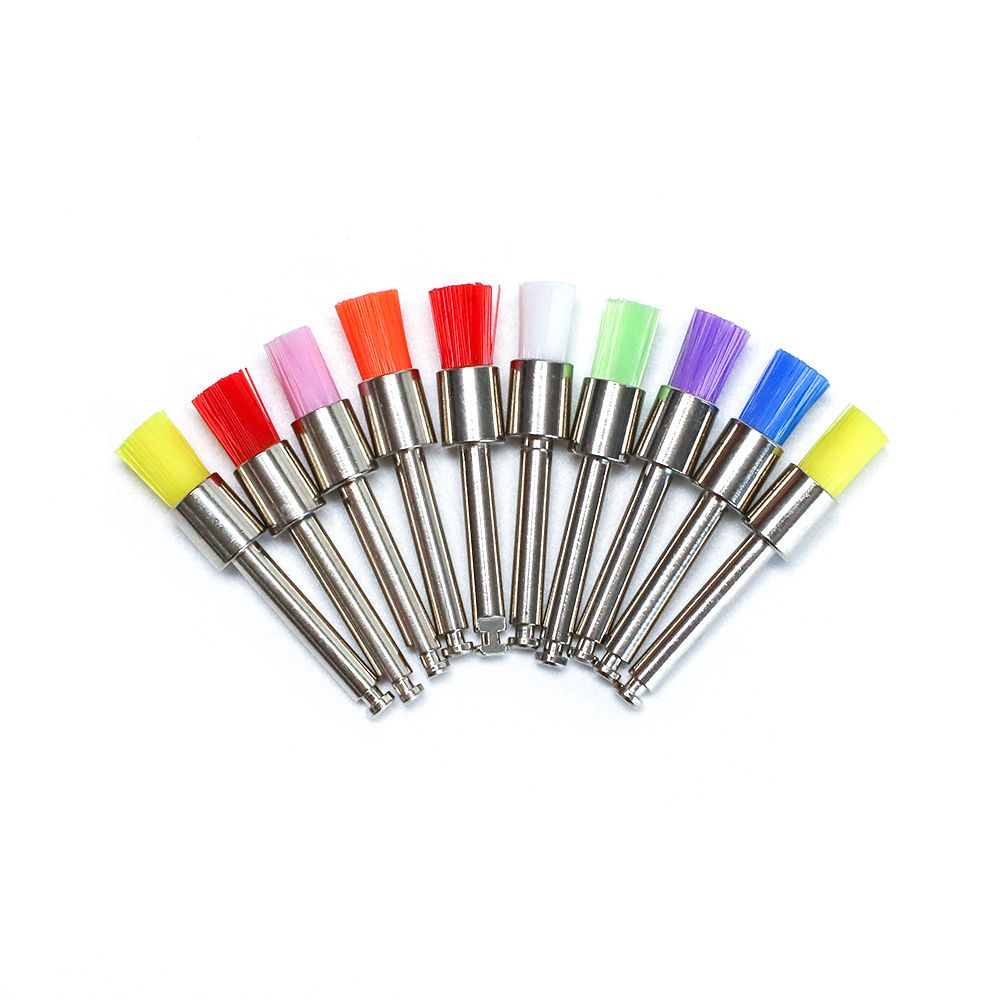
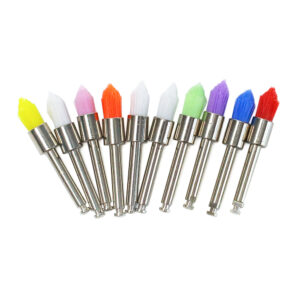
- Available in multiple bristle colors including white, yellow, red, blue, green, orange, pink, purple, and teal for procedure and size differentiation
- Particularly suited for interproximal surface polishing, fissure cleaning, implant surface maintenance, and restoration margin finishing where rubber cup rims cannot achieve complete surface contact
- Supplied in clear plastic storage boxes and resealable polybags for organized chairside access
- Single-use design eliminates cross-contamination risk between patients
- Shelf life: 3 years
Description
The Disposable Dental Polishing Brush is a single-use nylon bristle prophylaxis attachment designed for use with low-speed latch-type contra-angle handpieces during routine dental cleaning, interproximal polishing, implant surface maintenance, fissure cleaning, and restoration surface finishing. The polishing brush provides access to surface zones and anatomical features — interproximal contacts, fissure depths, implant surface textures, and concave restoration margins — that the solid rim of a rubber polishing cup cannot reach, making it a complementary and often essential part of a complete prophylaxis instrument set.
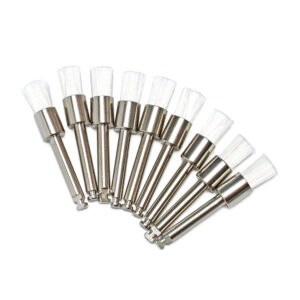
As visible across the product images, the brush is available in three distinct bristle head profiles. The flat-top brush features a cylindrical bristle cluster with a level tip surface suited to broad occlusal, buccal, and lingual surface polishing on posterior teeth. The pointed/tapered brush features a bristle cluster that converges to a fine tip, enabling directed access to fissure anatomy, narrow interproximal embrasure spaces, and concave restoration margins. The cup-shaped brush features a bowl-geometry bristle arrangement that conforms to the convex labial and buccal surfaces of anterior and posterior teeth, distributing bristle contact evenly across a curved surface in a single rotational stroke. All three profiles use the same latch-type stainless steel shank and are available in multiple bristle colors — including white, yellow, red, blue, green, orange, pink, purple, and teal — enabling color-coded selection by brush profile, procedure type, or provider preference. The product is supplied in clear plastic storage boxes and resealable polybags.
Feature
- The fine nylon bristle construction enables the brush to conform to irregular surface topography — including the micro-texture of implant surfaces, the concave anatomy of interproximal embrasures, and the fissure geometry of occlusal surfaces — making contact with surface areas that the solid, non-conforming rim of a rubber polishing cup cannot reach during rotary polishing.
- The bristles are secured within a stainless steel ferrule cup that retains the full bristle bundle under the rotational load and contact pressure of clinical polishing use, preventing bristle splaying, bundle displacement, or individual bristle loss at the tooth surface during the polishing stroke — maintaining consistent bristle geometry and contact area from the first stroke to the last.
- The pointed/tapered bristle profile, visible clearly in the product images, converges to a fine tip that can be directed into the narrowest fissure anatomy, the deepest interproximal embrasure accessible from the buccal or lingual approach, and concave margin areas of ceramic and composite restorations — accessing zones where a flat-top brush or rubber cup would make only peripheral contact.
- The flat-top bristle profile provides a broad, even bristle contact surface across the full diameter of the brush head for efficient polishing of large posterior occlusal, buccal, and lingual surfaces — covering more surface area per stroke than the pointed profile and reducing the number of strokes required to complete occlusal surface cleaning in routine prophylaxis.
- The cup-shaped bristle profile creates a concave bristle surface that conforms to the convex curves of anterior labial surfaces, buccal surfaces of posterior teeth, and the emergence profiles of implant-supported crowns, distributing rotational polishing force evenly across the full curved surface contact zone rather than concentrating it at the center bristles as a flat-top brush would on a convex surface.
- The latch-type stainless steel shank engages the latch mechanism of standard low-speed contra-angle handpieces with a single axial insertion — no tools required — providing secure, wobble-free attachment that transmits full rotational force from the handpiece to the bristle head without vibrational artifact that would reduce polishing contact consistency.
- Available in multiple bristle colors across all three head profiles, enabling clinics to establish color-coded brush protocols by profile type, abrasive level of the paired prophy paste, or tooth zone assignment — and providing immediate chairside identification of the correct brush profile without label reading during the procedure.
Polishing Brush — Specifications
| Parameter | Specification |
|---|---|
| Product Name | Disposable Dental Polishing Brush |
| Bristle Material | Nylon |
| Ferrule Material | Stainless Steel |
| Shank Type | Latch-Type Stainless Steel |
| Shank Compatibility | Standard Low-Speed Latch-Type Contra-Angle Handpiece |
| Bristle Head Profiles | Flat-Top, Pointed/Tapered, Cup-Shaped |
| Available Colors | White, Yellow, Red, Blue, Green, Orange, Pink, Purple, Teal |
| Packaging | Clear Plastic Storage Box; Resealable Polybag |
| Use | Single-Use |
| Storage | Well-ventilated; moisture-proof; indoor temperature ≤ 45°C |
| Shelf Life | 3 Years |
Working Principle
The Dental Polishing Brush transmits the rotational force of the low-speed handpiece through the stainless steel latch shank and ferrule to the nylon bristle cluster, creating a rotating bristle contact surface at the tooth or restoration interface. When the rotating brush is loaded with prophy paste and brought into contact with the target surface, the abrasive particles in the paste are carried across the surface by the individual bristle tips moving through their rotational arc, removing surface stain, plaque biofilm, and debris through the combined action of mechanical bristle contact and abrasive particle friction.
The functional distinction between the polishing brush and the rubber polishing cup lies in the geometry of the working surface. The rubber cup presents a solid, relatively inflexible working surface that contacts the tooth through rim flexion; its effective contact zone is limited to the cup rim and the adjacent area of the cup face. The polishing brush presents individual bristle tips that are independently mobile — each bristle deflects individually under contact with an irregular surface, allowing the bristle tips to follow surface contours, enter fissure recesses, and access interproximal and concave surface zones that the cup rim cannot reach. This independent bristle mobility is the primary functional advantage of the brush format over the cup for surfaces with complex anatomy.
The three bristle head profiles exploit this bristle mobility in different geometric configurations. The flat-top profile distributes bristle tips evenly across a cylindrical contact plane, maximizing contact area per stroke on flat or slightly convex surfaces. The pointed/tapered profile concentrates the bristle tips at a convergent point, directing the bristle contact toward a focal zone for precise access to narrow anatomical features. The cup-shaped profile arranges the bristle tips in a concave geometry that inverts the radius of a convex tooth surface, maximizing the number of bristle tips in simultaneous contact with a curved surface during each rotational pass.
Clinical Practice of the Disposable Dental Polishing Brush
1. Pre-Procedure Setup
- Select the appropriate bristle head profile for the procedure: flat-top for broad posterior occlusal and buccal surface polishing; pointed/tapered for fissure cleaning, interproximal embrasure access, concave restoration margin polishing, and implant surface maintenance in areas with restricted access geometry; cup-shaped for anterior labial and buccal surface polishing where convex surface conformation is required.
- Insert the latch shank into the latch-type contra-angle handpiece and confirm positive engagement before handpiece activation.
- Run the handpiece unloaded briefly at low speed to confirm smooth, vibration-free rotation at the selected brush head before introducing it intraorally; a brush that shows eccentric rotation or vibration at low speed indicates a handpiece latch or shank fit issue that should be resolved before clinical use.
- Load the brush by briefly contacting the bristle tip with the surface of the prophy paste in the dappen dish; use a lighter loading touch than for rubber cups — the nylon bristles hold paste in the inter-bristle spaces by surface tension and release it efficiently at the tooth surface without the need for a heavy paste charge.
2. Intraoperative Management
- Apply the loaded brush to the tooth surface with light, controlled contact pressure — the bristle tips should flex slightly on contact, indicating full bristle cluster engagement with the surface. Avoid heavy contact pressure that fully collapses the bristle bundle against the ferrule; this eliminates the individual bristle mobility that is the functional advantage of the brush format.
- For fissure cleaning with the pointed brush, direct the bristle tip into the fissure entrance and use light in-and-out strokes combined with rotation to carry prophy paste into the fissure depth; do not apply downward pressure to force the bristle tip into the fissure beyond the natural extent of bristle penetration under light contact load.
- For interproximal polishing with the pointed brush, approach from the buccal or lingual aspect and direct the bristle tip into the embrasure space with light rotational contact against the interproximal surface; monitor gingival tissue carefully to avoid bristle contact with the interdental papilla under excess lateral pressure.
- For implant surface maintenance, use the pointed or flat-top brush profile with a non-abrasive or implant-specific polishing paste; confirm that the paste selected is compatible with the implant surface material before beginning polishing — titanium and zirconia implant surfaces have different surface roughness requirements and paste compatibility profiles.
- Reload the brush with prophy paste between tooth surfaces as needed; nylon bristles release paste more rapidly than rubber cups and may require more frequent reloading for complete surface coverage.
- Stop using any brush that shows visible bristle loss, ferrule deformation, or shank loosening during use; replace immediately.
3. Post-Procedure Disposal
- Remove the polishing brush from the handpiece latch by pressing the latch release and withdrawing the shank axially.
- Discard immediately after each patient use; single-use only. Do not reuse, re-sterilize, or re-disinfect.
- Clean the contra-angle handpiece latch mechanism according to the handpiece manufacturer’s protocol before reuse or sterilization.
- Dispose of used brushes in accordance with local clinical waste regulations.
The Function of the Disposable Dental Polishing Brush
The Disposable Dental Polishing Brush extends the clinical reach of the prophylaxis polishing workflow to surface zones that the rubber polishing cup cannot effectively address. The rubber cup is the correct instrument for broad, accessible tooth surfaces — buccal, lingual, and flat occlusal zones — where its solid rim and cup face can maintain consistent contact and carry prophy paste across a large area efficiently. It is not the correct instrument for fissure anatomy, interproximal embrasures, concave restoration margins, or implant surface textures, where the solid rim cannot conform to the surface geometry and contact is limited to the most convex point of the target zone.
The polishing brush resolves this limitation through its independent-bristle contact mechanism. Individual nylon bristles are sufficiently fine and independently mobile to enter fissure openings, follow concave margin profiles, reach the depth of interproximal embrasures accessible from the buccal or lingual approach, and adapt to the micro-texture of implant surfaces — areas where any solid-rim instrument is inherently excluded by geometry. In a complete prophylaxis sequence, the brush and cup are complementary instruments rather than alternatives: the cup cleans large accessible surfaces efficiently, and the brush completes the surface coverage by reaching the zones the cup cannot.
The three head profiles — flat-top, pointed, and cup-shaped — define the specific access capability of the brush at three distinct surface geometry types. The pointed profile is the most clinically distinctive: no other polishing instrument available in a standard prophy instrument set provides the combination of a fine convergent tip, independent bristle mobility, and rotary handpiece drive that the pointed polishing brush offers for fissure and embrasure access. For clinics performing complete supra-gingival prophylaxis with attention to stain and biofilm removal in all anatomical zones, the pointed polishing brush is not a supplementary option but a clinical necessity for complete surface coverage.
Important Notes for Using the Disposable Dental Polishing Brush
- For use only with straight handpieces or latch-type contra-angle handpieces that meet technical and hygienic standards and are regularly maintained. Confirm latch engagement before every intraoral use by applying light lateral force to the brush head — a brush not fully latched may detach during rotation.
- Confirm smooth, vibration-free rotation before intraoral use. Eccentric rotation at the brush head indicates a shank fit or handpiece latch issue; do not use a brush that vibrates at the head during low-speed rotation, as eccentric motion increases soft tissue trauma risk and reduces polishing consistency.
- Apply only light contact pressure during polishing. The functional advantage of the nylon bristle brush — individual bristle tip mobility — is eliminated by heavy contact pressure that collapses the bristle bundle. Light pressure maintains bristle tip mobility and surface following capability; heavy pressure reduces the brush to a blunt abrasive pad.
- Do not force the bristle tip into fissures or embrasures beyond natural bristle penetration under light pressure. Forced insertion of the brush tip into a fissure beyond the depth reached under normal contact load can cause gingival trauma at the fissure entrance and does not improve cleaning depth significantly — prophy paste carried by the bristle tip provides the cleaning action at depth, not mechanical bristle contact.
- Monitor gingival tissue during interproximal polishing. The pointed brush tip in an interproximal embrasure is in close proximity to the interdental papilla; excess lateral pressure toward the gingival margin risks bristle contact with soft tissue. Use light pressure and confirm tip position before activating rotation in the embrasure.
- Confirm prophy paste compatibility before use on implant surfaces. Titanium implant surfaces require non-abrasive or implant-compatible paste; standard abrasive prophy paste can alter surface roughness on titanium in a clinically significant way over repeated polishing cycles. Always verify paste suitability for the specific implant surface material being polished.
- Stop using immediately if bristle loss, ferrule deformation, or shank loosening is observed during use. Individual bristle loss during intraoral rotation creates a foreign body risk; ferrule or shank failure during rotation creates a detachment risk. Replace the brush immediately upon any sign of structural compromise.
- If a patient is known to be allergic to any component of the brush — including nylon, stainless steel, or any material in the prophy paste used — do not use without clinical evaluation of the allergy risk.
- Single-use only. Destroy after use. Do not reuse, re-sterilize, or re-disinfect. Store unused brushes in a well-ventilated, moisture-proof environment at indoor temperature not exceeding 45°C.
评价
目前还没有评价